
Introduction
Building backlinks is a common part of an SEO strategy, but getting a link published is only one step in the process. You might publish a guest post, earn a niche edit, create a business profile, or receive a link from an industry website and then discover that the referring page is not appearing in Google's search results.
This raises an important question: how do you get backlinks indexed in Google, and what should you do when newly published links are not showing up?
The answer starts with understanding that publishing a backlink, getting the referring page crawled, indexing that page, and Google recognizing the link are different things. A link can exist on a live webpage without that page appearing in Google's index. Even when a referring page is indexed, Google does not guarantee that the link will influence rankings.
In this guide, you'll learn how to index backlinks fast in Google using practical methods for guest posts, niche edits, profile links, and tiered link structures. You'll also discover how to assess backlink quality with a Backlink Quality Checker, troubleshoot indexing delays, and evaluate a Backlink Indexing Service without relying on unrealistic guarantees.
Whether you're managing a personal website, a business website, or an SEO campaign for clients, these steps can help you build a more reliable backlink monitoring process.
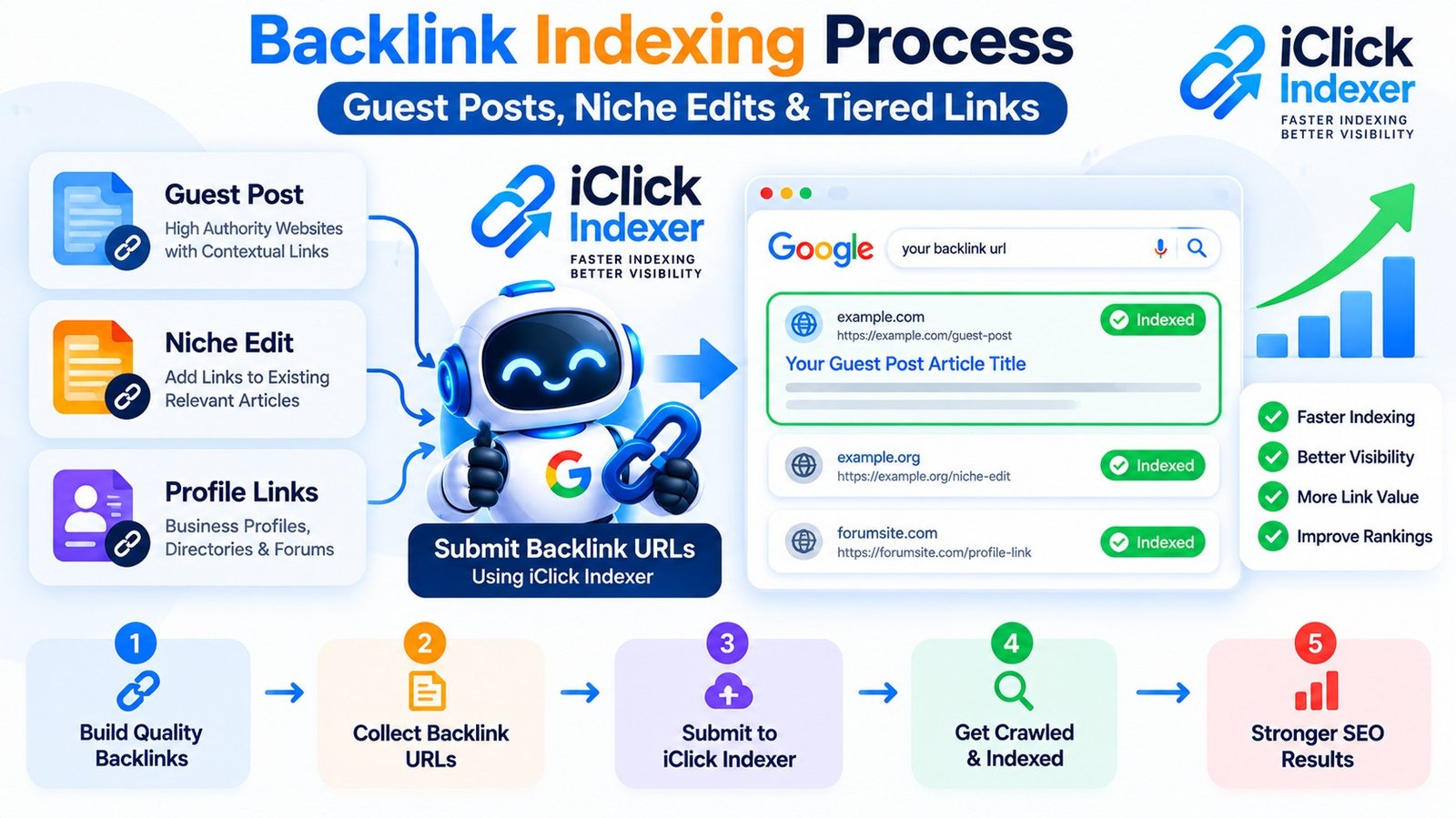
📷 Backlink Indexing Process: Guest Posts, Niche Edits & Tiered Links Step-by-Step Guide
What Is Backlink Indexing?
Backlink indexing refers to the process of Google discovering and potentially including the webpage containing a backlink in its search index.
For example, suppose a technology blog publishes an article that links to your website. The link is live, but the article may not have been crawled or indexed by Google yet.
If Google discovers the article, crawls it, and decides to include it in its index, the referring page may become searchable. However, Google does not guarantee that every published page will be indexed or that every link will be used as a ranking signal.
It is also important to distinguish between a referring page being indexed and a backlink appearing in a third-party backlink tool. Different SEO platforms maintain their own crawlers and databases, so their backlink reports may not match Google's information.
Google Search Console's Links report provides information about links Google has found to your website, but it is not a complete list of every backlink. You can review the official Google Search Console Links report documentation.
Why Are My Backlinks Not Indexing?
Before using a backlink indexing tool or service, identify why the referring page may not be indexed.
1. The Referring Page Is New
Newly published pages may take time to be discovered, crawled, and evaluated. A website that publishes infrequently may have fewer reasons for Google to revisit a particular page quickly.
What to do: Confirm that the page is live, linked from relevant sections of the publisher's website, and accessible without restrictions.
2. The Referring Page Has Little Original Value
A guest post that contains generic information, repetitive text, or little useful detail may not offer enough value for Google to include it in search results.
What to do: Work with publishers that maintain useful editorial standards and publish content for real readers rather than solely to host backlinks.
3. The Page Is Blocked or Restricted
The referring page may contain a noindex directive, require authentication, return an error, or have other technical problems that prevent normal indexing.
What to do: Check the page's HTTP response, accessibility, and visible content using our free Google Indexability & NoIndex Checker. If you control the referring website, inspect its indexing directives and server configuration.
4. The Page Is a Duplicate or Alternate Version
Google may select a different canonical URL for a page with substantially similar content. The published URL may therefore remain outside the index even though another version is indexed.
What to do: Review canonical signals where you have access and ask the publisher to resolve unintended duplication.
5. The Website Has Weak Discovery Paths
A page that is isolated from the publisher's main content structure may be difficult to discover.
What to do: Where appropriate, ask the publisher to add a contextual internal link from a relevant, established page or category.
6. The Backlink Is Low Quality or Manipulative
Large numbers of irrelevant, automated, or artificially created links can create risk rather than improve SEO performance.
What to do: Evaluate the relevance and editorial quality of each link. Avoid mass link creation designed primarily to manipulate search rankings.
Remember that a backlink not appearing in Google's index does not automatically mean it is harmful. Equally, getting a backlink indexed does not automatically make it valuable.
How to Index Backlinks Fast in Google: 10 Practical Steps
Use this process to improve the discoverability and technical accessibility of backlink pages. These methods can help Google find useful content, but none guarantees indexing.
Step 1: Verify That the Backlink Is Live
Start by opening the exact referring URL where your backlink was published (or check multiple links at once with our Free Backlink Quality & Anchor Auditor).
Check the following:
- The page loads successfully.
- The content is visible without logging in.
- The backlink points to the intended destination.
- The link is not broken or redirected unexpectedly.
- The referring page contains the expected article or profile information.
If the link has been removed, no indexing tool can restore it. Contact the publisher first and resolve the publication issue.
Keep a record of the referring URL, target URL, publication date, anchor text, and current status.
Step 2: Check Whether the Referring Page Is Indexed
Search for the exact page URL in Google and review any available search results. You can also search for a distinctive sentence from the article as an additional clue.
However, a site: search is not a definitive indexing test. Search operators may return incomplete results, so the absence of a URL from those results does not conclusively prove that Google has not indexed it.
For websites you own or manage, use Google Search Console's URL Inspection tool. For third-party guest post pages, you generally won't have access to the publisher's private Search Console data.
If the publisher is willing to help, ask them to check the page's indexing status directly.
Step 3: Evaluate the Quality of the Referring Website
Not all backlinks deserve the same level of attention.
Assess the referring site using several factors:
- Topical relevance: Does the site publish content related to your industry?
- Editorial standards: Are articles useful, readable, and reviewed?
- Organic visibility: Does the site have evidence of real search visibility?
- Content quality: Is the material original and maintained?
- Audience relevance: Would the site's readers genuinely benefit from visiting your website?
- Link placement: Is the link placed naturally in relevant content?
A third-party authority score can be a useful comparison metric, but it is not an official Google ranking score. A high Domain Authority or Domain Rating does not guarantee indexing, ranking improvements, or link value.
Step 4: Improve Internal Links on the Referring Page
If you own the referring website, make the page easier to discover through relevant internal links.
For example, a guest article about technical SEO might be linked from a category page or another established article about website optimization.
Google recommends using crawlable links so that its systems can discover pages and understand their relationships.
If you do not control the referring site, you can request a relevant internal link from the publisher. The decision should depend on editorial value, not simply on the desire to manipulate search engines.
Official guidance: Google's link best practices.
Step 5: Make Sure the Link Is Crawlable
If you control the referring page, check that the backlink is implemented as a normal HTML anchor with a valid href attribute.
For example:
<a href="https://example.com/seo-services/">
  SEO services
</a>
This is a standard crawlable link format. Google may not reliably extract URLs from arbitrary elements or JavaScript actions that do not behave like normal links.
Also verify that the destination URL works and resolves to the intended page.
For sponsored placements, paid links, and user-generated content, use the appropriate link qualification attributes. Do not remove required sponsored or nofollow attributes merely to try to influence indexing.
Step 6: Improve the Referring Page's Content
If you publish guest posts or manage the referring website, prioritize content that answers a real reader's question.
A useful guest post should have:
- A clear topic and purpose.
- Original explanations and relevant examples.
- Accurate information.
- Logical headings and readable paragraphs.
- Sources for claims that require verification.
- Links that genuinely help readers explore related information.
Avoid publishing dozens of near-identical guest posts across unrelated websites just to create backlinks.
The objective is to earn relevant editorial mentions and useful referral traffic, not simply to increase the number of URLs containing your link.
Step 7: Use Sitemaps and Supported Discovery Methods Where Appropriate
If you control the referring website, include the preferred, indexable page URL in its XML sitemap when appropriate.
A sitemap helps search engines discover URLs, but it does not guarantee crawling or indexing.
If you do not control the referring website, you cannot directly update its sitemap or submit its pages through its Search Console property. Ask the publisher to review those options if the page deserves to be indexed.
For your own website, keep the XML sitemap clean and ensure that it contains the preferred URLs you want Google to discover.
Step 8: Monitor the Backlink Using Reliable Tools
A backlink monitoring workflow helps you identify missing links, broken pages, and changes in referring-page status.
Record each backlink's source URL, target URL, anchor text, publication date, link attributes, and last checked date.
For your own site, Google Search Console's Links report can provide useful information about external links Google has found. Remember that this report is a sample and not a complete inventory.
Third-party backlink platforms may provide additional information about referring domains and page-level metrics, but their crawlers and index databases operate independently of Google's index.
Step 9: Recheck the Page After Technical or Editorial Changes
If the publisher fixes a technical issue, restores a missing article, improves internal links, or updates a sitemap, recheck the referring page after those changes have had time to be processed.
Avoid submitting the same URL repeatedly without making meaningful changes.
For your own pages, the URL Inspection tool can help you inspect the current state and request indexing when appropriate. For pages on external websites, the publisher is responsible for its Search Console requests and technical settings.
Step 10: Prioritize Valuable Backlinks Instead of Every URL
If you have hundreds or thousands of backlinks, start with the links most likely to be useful to your website.
Prioritize links from relevant publications, useful guest posts, genuine industry resources, and pages that could send qualified referral traffic.
Investigate broken or removed links, and distinguish between technical issues and pages that Google simply has not chosen to index.
A smaller set of relevant editorial links can be more useful than a large list of low-quality links. Indexing every backlink should not be the main measure of SEO success.
How to Get Guest Post Backlinks Indexed
Guest posts can introduce your business to new audiences and provide useful references within relevant editorial content. Their value depends on the publication, topic, link placement, and editorial context.
To improve discoverability:
- Choose publications that have real readers and relevant subject matter.
- Submit original articles that meet the publisher's quality standards.
- Ensure the article has a stable, publicly accessible URL.
- Use descriptive titles and meaningful internal links where appropriate.
- Check whether the page is accessible and whether the publisher has excluded it from indexing.
- Monitor the URL after publication.
Is a Guest Post Indexing Service Necessary?
A Guest Post Indexing Service may offer URL monitoring, technical checks, or supported discovery workflows. Before purchasing one, determine exactly which actions it performs.
Ask whether it verifies that the guest post is live, checks indexing signals, reports changes, and explains unsuccessful outcomes. Be cautious of services that promise guaranteed indexing for every guest post.
If the guest post is thin, duplicated, blocked, or published on a site created primarily to sell links, submitting it to more tools will not resolve the underlying quality or policy concerns.
How to Handle Niche Edit and Contextual Backlinks
A niche edit is typically a link added to an existing article rather than a newly published guest post.
Because the referring page already exists, first inspect its current accessibility, content relevance, and publication status.
Check whether the article has been updated appropriately and whether the new link makes sense in context.
If the link is part of a paid placement, the publisher should qualify it appropriately. Buying a link that passes ranking credit in violation of Google's spam policies creates risk regardless of whether the page becomes indexed.
A useful contextual link should help readers understand a subject, explore a related resource, or verify a claim.
How to Approach Tier 1, Tier 2, and Tier 3 Backlinks
Tiered link building organizes backlinks into layers. Tier 1 links point directly to your website, while Tier 2 links point to pages containing Tier 1 links. Tier 3 links may point to pages in the second tier.
This structure is used in some SEO strategies, but it can become risky when the primary purpose is to manufacture ranking signals through automated or low-quality links.
Tier 1 Backlinks
Tier 1 links point directly to your website.
Focus on editorial relevance, useful content, crawlable link implementation, and accurate destination URLs. A relevant publication that attracts genuine readers is generally a better prospect than a page created solely to host a backlink.
Tier 2 Backlinks
Tier 2 links point to pages that link to your website.
Evaluate them as independent pages. A link to a guest post does not guarantee that Google will index the guest post or recognize the link inside it.
If the second-tier page is useful, relevant, and technically accessible, normal discovery methods may help Google find it.
Tier 3 Backlinks
Tier 3 links point to pages in the second tier.
Large-scale automated tiered linking, low-quality directories, and mass-produced links can create spam risks. Do not assume that adding more layers will improve the value of the original backlink.
Rather than using a Tier 2 Backlink Indexer to push large volumes of URLs, assess whether each referring page offers genuine value and whether the linking strategy complies with Google's policies.
Official reference: Google Search spam policies.
Can a Backlink Indexing Service Speed Up Indexing?
A Backlink Indexing Service may help organize URL submissions, identify accessibility problems, monitor page status, or support discovery through permitted methods.
However, the term covers different services, and their actual capabilities vary.
Before choosing a provider, ask:
- Does the service verify that each backlink is live?
- Does it check whether the referring page is accessible?
- Does it report indexing status or merely submit URLs?
- Does it use supported methods?
- Does it explain unsuccessful results?
- Does it avoid automated link creation and unrealistic guarantees?
A service that only resubmits URLs cannot guarantee that Google will crawl or index them.
What About a Fast Backlink Indexer?
A Fast Backlink Indexer is usually marketed as a way to help URLs get discovered more quickly. Before using one, verify the actual process and whether it complies with search engine policies.
Avoid tools that create large numbers of artificial links to your backlink URLs or claim guaranteed indexing through undocumented methods.
Speed is not the only consideration. The quality and usefulness of the referring page matter too.
Is a Fast Google Indexing Service Suitable for Every Backlink?
No. A Fast Google Indexing Service may provide monitoring or supported URL submission features, but not every backlink needs to be indexed, and no service can guarantee inclusion in Google Search.
Prioritize useful pages that have legitimate editorial value. If a backlink comes from an irrelevant or manipulative source, reconsider whether it belongs in your SEO strategy at all.
Should You Use a URL Indexer?
A URL Indexer can refer to software that organizes URL lists or facilitates discovery workflows. Check its documentation carefully to understand what it actually does.
For websites you own, Google's URL Inspection and sitemap features are useful starting points. For external pages, you generally need the publisher's cooperation to access private indexing tools.
Do not assume that any third-party tool can directly force Google to index arbitrary URLs.
How to Use a Backlink Quality Checker
A Backlink Quality Checker is useful when evaluating the overall health and relevance of your backlink profile.
Use a combination of technical checks, editorial judgment, and available reporting data.
| Check | What to examine |
|---|---|
| Relevance | Is the referring page related to your industry or topic? |
| Live status | Does the page load and is the link still present? |
| Link destination | Does it point to the correct URL? |
| Link attributes | Is the link marked nofollow, sponsored, or another relevant attribute? |
| Page quality | Does the referring page offer useful, original content? |
| Website credibility | Does the publisher have real editorial standards and a relevant audience? |
| Indexing signals | Is there evidence that the referring page appears in search results? |
| Link pattern | Does the backlink look natural or part of a manipulative scheme? |
No single metric can establish whether a backlink is valuable. Domain-level scores, estimated traffic, and indexing checks are supporting indicators rather than guarantees of ranking benefit.
Common Backlink Indexing Mistakes to Avoid
Repeatedly Submitting the Same URLs
Repeated submissions do not guarantee that Google will index a page. Check the underlying problem and make meaningful improvements where needed.
Buying Guaranteed Indexing Packages
Be skeptical of providers promising that every backlink will be indexed within a fixed number of hours or days. Google's indexing decisions are not controlled by third-party providers.
Creating Automated Links to Every Backlink
Automated link generation designed to manipulate ranking signals can violate Google's spam policies. More links do not necessarily mean better SEO.
Ignoring Link Quality
A backlink from a page with no relevant audience or useful content may offer little value, even if the page is indexed.
Treating Third-Party Reports as Google's Complete Index
SEO tools maintain independent databases. Differences between those reports and Google Search Console do not automatically mean that something is wrong.
Focusing Only on Indexing Counts
Track referral traffic, relevant linking sites, link persistence, content quality, and organic performance. The number of indexed backlink pages alone is not a reliable measure of campaign success.
Frequently Asked Questions
1. How to Index Backlinks Fast in Google?
Start by confirming that the referring page is live, accessible, and contains the correct link. Improve relevant internal linking on pages you control, use sitemaps where appropriate, and monitor indexing signals. These steps can support discovery but cannot guarantee indexing.
2. How to Get Backlinks Indexed?
Make sure the source page offers useful content, returns a successful response, and is not unintentionally excluded from indexing. If you control the page, review its technical settings and internal links. If another publisher owns it, request assistance where necessary.
3. Why Are My Backlinks Not Indexing?
Possible causes include delayed discovery, low-value content, duplication, canonical selection, access restrictions, or technical problems. A third-party SEO tool may also have failed to discover the link, even if the source page is available to Google.
4. Does Google Index Every Backlink?
No. Google does not guarantee that every referring page will be indexed or that every link will be used as a ranking signal.
5. Is a Backlink Indexing Service Safe?
It depends on what the service does. Monitoring and technical auditing are different from automated link creation or manipulative submission schemes. Evaluate the provider's methods and avoid guaranteed-indexing claims.
6. Can Tier 2 Backlinks Help Tier 1 Links Get Indexed?
A relevant link to a Tier 1 page may help discovery, but it does not guarantee that the Tier 1 page will be crawled or indexed. Evaluate every page for quality and policy compliance.
7. What Is the Difference Between a Backlink Indexer and a Backlink Quality Checker?
A backlink indexer generally focuses on URL submission or discovery workflows. A backlink quality checker evaluates characteristics such as relevance, link placement, technical status, and potential risks. Some products offer both features.
8. Should I Index Profile Backlinks?
First determine whether the profile is useful, publicly accessible, and relevant. Profile links vary significantly in quality and may be marked nofollow or otherwise qualified. Creating large numbers of profiles solely for SEO can be counterproductive.
9. How Long Does Backlink Indexing Take?
There is no fixed timeline. A page may be discovered quickly, take longer to be crawled, or never be included in the index. The publisher's website, content quality, and technical conditions can all affect the outcome.
10. Can I Guarantee Backlink Indexing for My Clients?
No. You can provide transparent monitoring, technical checks, reporting, and quality-focused recommendations, but you cannot guarantee that Google will index every backlink. Explain the scope and limitations of any indexing service clearly.
Conclusion
Learning how to index backlinks fast in Google starts with understanding how search engines discover, crawl, and evaluate referring pages. Guest posts, niche edits, profile links, and tiered backlinks all require different levels of quality assessment, but the fundamentals remain the same: accessibility, useful content, crawlable links, and legitimate discovery paths.
A Backlink Indexing Service, Fast Backlink Indexer, or URL Indexer may support particular workflows, but none can guarantee that Google will include every referring page in its index.
For the most reliable approach, verify each backlink, evaluate the referring page, improve the aspects you control, and monitor results using appropriate tools. Focus on relevant, editorially sound backlinks rather than chasing indexing counts alone.
The best backlink strategy is not simply to get more URLs indexed. It is to earn links that make sense for your audience and support a trustworthy, useful website.